Valencia Airport
Hand luggage: dimensions, liquids and regulations
Hand luggage
Each passenger may check baggage according to the class of their airline ticket and may also take a number of light items of a certain size into the aircraft cabin; these are classed as hand luggage.
Standard dimensions
Hand luggage generally consists of two pieces: a personal item, such as a handbag or small backpack, and one item of baggage. This second item must fit inside the baggage size gauge, displayed at check-in desks as an example, and must not exceed: 114 cm (56 x 35 x 23 cm), or 22'' long x 14'' wide x 9'' high. Its weight varies by airline, between 5 and 7 kg. You must check in the rest of your baggage at your airline's check-in desk during check-in.
Some low-cost airlines limit hand luggage to one small item that must fit under the seat in front. To take the second, larger item into the cabin, you may have to pay or buy a more expensive ticket, or check it in at the check-in desk, sometimes free of charge. Check with your airline.
Security screening
Under security regulations, passengers must pass through security screening before entering passenger-only areas. Screening uses walk-through metal detectors for people and X-ray equipment for baggage. If required by security staff, it may be supplemented by a thorough manual inspection. If your hand luggage contains a laptop, tablet or another electronic device, you will generally be asked to remove it from its carrying case for examination. Liquids are accepted or refused during this screening.
Would you like to skip the security queue? Fast Lane reduces the time spent getting through security and lets you reach the departure area or VIP lounges sooner.
In the hand-luggage section:
Prohibited items in hand luggage
Before packing hand luggage, note that passengers may not take into the security restricted area, or into the aircraft cabin, any item that could endanger the health of passengers and crew or the safety of the aircraft and its property. Such items must be checked in as baggage and/or undergo the appropriate procedure to be carried; otherwise, security staff may confiscate them. Security staff may also deny access to the restricted area and cabin to any passenger carrying a suspicious item, even if it is not listed among prohibited items.
For your own safety and that of other passengers, do not check in or carry baggage belonging to people you do not know.
Liquids, gels and baby food
The European Union sets a number of restrictions on carrying liquids and gels on board aircraft.
These measures apply to all passengers departing from airports in the European Union, Norway, Iceland and Switzerland, regardless of their destination. The limits affect the quantity of liquids, or substances with a similar consistency, that passengers may carry as hand luggage.
The regulations allow you to carry liquids in your hand luggage, provided that:
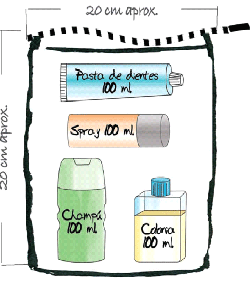
- Liquids are in containers with a maximum capacity of 100 ml.
- The containers are kept in a transparent, resealable bag that can be inspected easily and holds no more than one litre.
- A maximum of one bag per passenger is permitted.
The list below sets out liquids that may be carried in your hand luggage:
- Water and other drinks
- juices, soups, syrups, baby-bottle contents, yoghurt, spreads and baby food.
- Special foods or liquids
- for medical diets or special dietary requirements.
- Pastes and creams
- toothpaste, creams and lotions, oils, colognes, etc.
- Gels
- shampoos and hair gels, etc.
- Contents of pressurised containers (aerosols or sprays):
- deodorants, shaving foam, hair products, hairsprays and others with a similar consistency.
These limits apply only to what passengers bring with them. These liquids can be bought after security screening in the airport duty-free shops and even on board the aircraft. If these products are sold in sealed bags, do not open them until your journey has ended. If you are continuing your journey through another European Union airport, do not open the sealed bag until you have left the final EU airport.
These security measures affect only baggage you take with you on the aircraft, namely hand luggage. You may carry all the items described above in checked baggage.
Travelling with solid food in hand luggage
Yes, you can travel with food in your hand luggage. You only need to take account of your airline's hand-luggage size and weight limits. It is also advisable to carry it in an airtight container to prevent spills or odours. For carrying liquids in the cabin, see the section on liquids.
The European Union restricts the entry of products of animal origin, including meat, dairy products and by-products, to prevent the introduction of disease. The regulation does not apply to small quantities of powdered milk, baby food or pet food weighing less than 2 kg. Nor does it apply to small quantities for personal consumption from Andorra, Liechtenstein, Greenland, Iceland, Liechtenstein, Norway, San Marino or Switzerland. Other countries may apply similar laws; consult the health authorities and the consulate or embassy of your destination country.
Medicines
If you need to travel with solid medicines, it is advisable to carry them in your hand luggage. Keep the prescription, medical certificate or specific evidence of the passenger's condition with them, in case screening staff require it.
Liquid medicines are exempt from the restrictions on carrying liquids in hand luggage, provided they are needed by the passenger throughout the trip and its duration: outbound flight + stay + return flight.
Although the liquid rules do not apply in this case, liquid medicines must still be shown at security screening and presented separately from the transparent bag required for other liquids.
If you need to carry other medical equipment, such as diabetic syringes or measuring devices, it is advisable to check your airline's specific procedure before flying.
Prohibited items in hand luggage
Dangerous items
Any object or item that could pose a risk to the health of passengers and crew, or to the safety of the aircraft and its property, must be checked in as baggage and/or undergo the appropriate procedure before it may be carried.
There is no specific or definitive list of dangerous items because of their ambiguity (walking sticks, tripods, sports accessories, etc.); the final decision rests with security staff.
If you are unsure about an item, arrive with sufficient time to ask the security-screening staff.
Remember that items which your airline accepts as hand luggage may not be admitted to the security restricted area at later security checks, or vice versa.
- Dangerous items generales
- Sharp, cutting or blunt objects that could be used to intimidate, assault or endanger safety.
- Other dangerous items
- Any other item that endangers the health of passengers and crew.
- Any other item that endangers the safety of the aircraft and its property.
Chemical and toxic substances
The following items may not be carried as hand luggage or placed in the baggage hold:
- Acids and alkalis (for example, wet-cell batteries that could leak).
- Corrosive or bleaching substances (mercury, chlorine, etc.).
- Incapacitating or disabling sprays (mace, pepper sprays, tear gas, etc.).
- Radioactive material (for example, isotopes for medical or commercial use).
- Poisons.
- Infectious materials or materials posing a biological risk (for example, infected blood, bacteria and viruses).
- Materials capable of spontaneous ignition or combustion.
- Fire extinguishers.
Security staff may refuse carriage of any hold baggage containing an unlisted item that raises concerns.
Firearms
If you intend to carry firearms, you must go to the Firearms Office at the airport to obtain the required authorisation. Weapons must be packed in a suitable case and will be returned to you by the Firearms Office at the destination airport when you present the authorisation obtained at origin.
The items described below may not be carried as hand luggage, and must therefore be checked in.
- Any type of firearm: pistols, revolvers, shotguns, etc.
- Replicas or imitations of firearms or blank-firing guns.
- Parts of firearms, except scopes and telescopic sights.
Other types of weapons
- Air pistols and pellet guns.
- Flare guns.
- Starter pistols.
- Toy guns of any type (ball guns, etc.).
- Fixed-projectile guns and industrial-use guns.
- Crossbows, catapults, harpoons and spearguns.
- Animal slaughter guns or devices for stunning or delivering electric shocks, such as cattle prods or laser guns.
- Lighters or ignition devices shaped like firearms.
Firearms Office
Civil Guard
Terminal T1, floor 1, Departures hall.
(+34) 961 598 641.
Further information
Airport security forces: the Civil Guard and National Police in airport services.
Find more information about prohibited items in hand luggage and checked baggage at aeropuertosenred.com .
Would you like to skip the security queue? Fast Lane reduces the time spent getting through security and lets you reach the departure area or VIP lounges sooner.
Search the site

